
www.agritechmag.com
21
'26
Written on Modified on
GEO 3002 Sprayer Combines High Capacity with Precision Orchard Applications
Three-thousand-litre tank, 95,730 m³/h airflow and DETECT vegetation sensing support high-speed spraying, reduced product use and automated application control.
www.kuhn.com
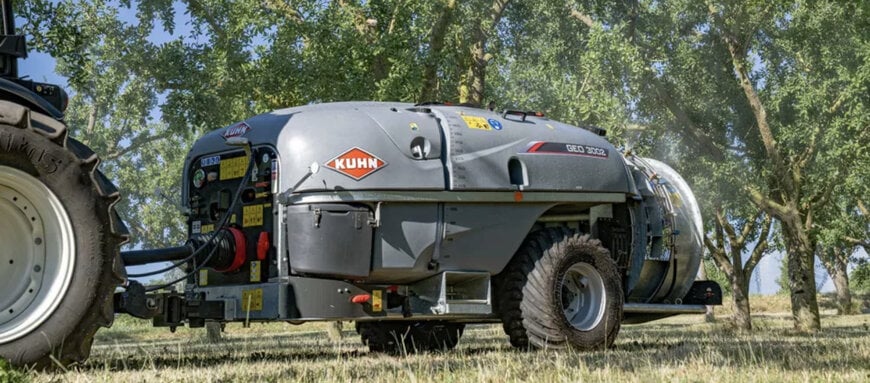
Agricultural implement manufacturer KUHN has introduced the GEO 3002 trailed orchard and vineyard sprayer, engineered to deliver high-volume chemical application and extended operational range across large specialty crop operations. The platform pairs a 3,000-liter payload with aerodynamic air-assisted delivery and sensor-based flow regulation to manage narrow application windows in dense plantation canopies.
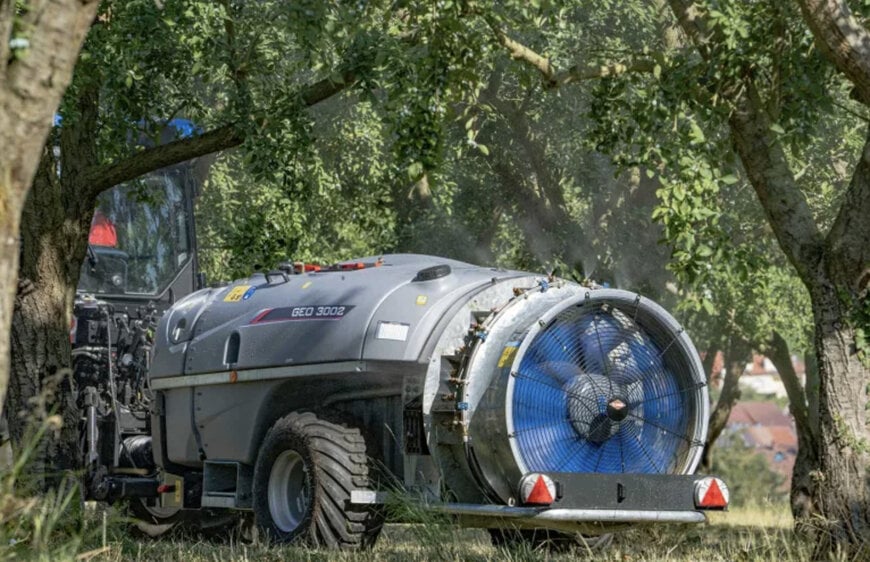
Fluid Handling and High-Flow Aerodynamic Delivery Architecture
Operating across expansive or fragmented orchard and vineyard parcels requires sustained spraying intervals between tank refills. The main 3,000-liter polyethylene reservoir is supported by an independent 300-liter rinsing tank, an optional triple-nozzle rotating rinse circuit, and a 30-liter chemical induction hopper configured for batch mixing of plant protection formulations. Hydraulic agitation and delivery are driven by a brass BHS 200 four-piston pump operating at a nominal displacement of 200 liters per minute, providing resistance against abrasive, suspended wettable powders and corrosive sulfur or copper solutions.
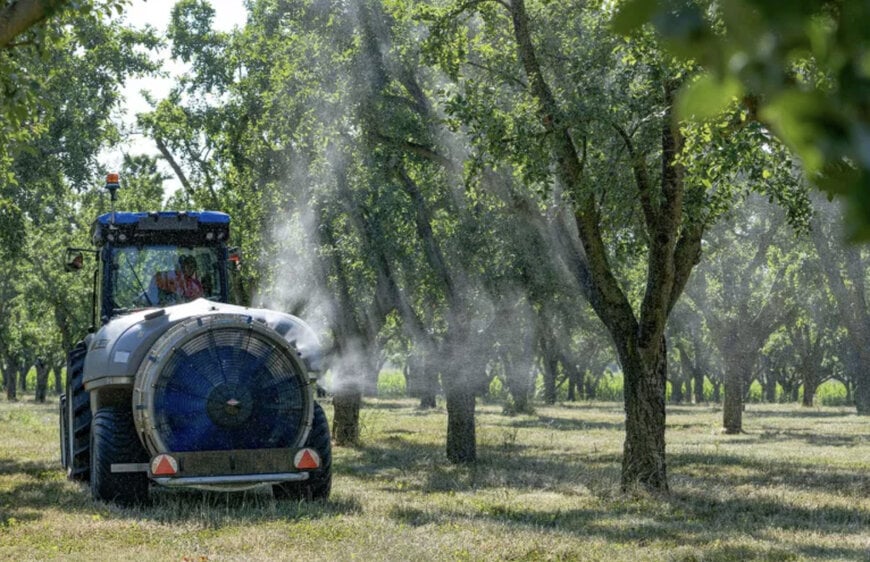
Airflow generation relies on the R-110-HF axial turbine, measuring 1,100 millimeters in diameter and producing volumetric airflow reaching 95,730 cubic meters per hour. The turbine integrates patented Wave Blades designed to optimize fluid dynamics, lowering aerodynamic drag, cutting operating noise emissions by up to 7 decibels compared to standard fan profiles, and lowering tractor power-take-off draw. Dispersal occurs through a dual-outlet air housing fitted with 26 adjustable dual-nozzle holders, directing spray droplets into dense foliage structures at elevated ground speeds.
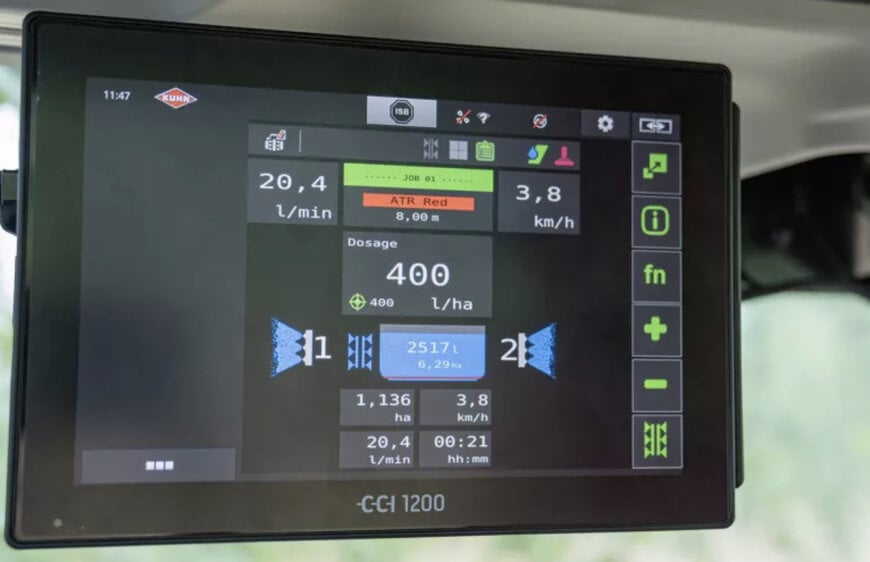
Canopy Sensing and Standardized Electronic Rate Regulation
Targeted distribution uses DETECT optical sensors integrated along the machine chassis to automate nozzle activation according to instantaneous foliage density. By halting delivery across physical row interruptions, missing vines, or irregular tree spacing, the sensor loop eliminates chemical over-application in unplanted zones. The control architecture functions in conjunction with proportional-to-forward-speed regulation systems, supporting standard BRAVO DPAE and ISOBUS interfaces.
Digital machine management utilizes tractor terminal integration or standalone CCI 800 and CCI 1200 interfaces to consolidate operating telemetry onto a single console within compact cab configurations. The onboard system enables GPS-guided automated section shut-off, real-time coverage mapping, field job logging, and dynamic application rate adjustment via pre-loaded prescription maps.
Additional Context:
This section details technical specifications and competitive benchmarking not included in the original product announcement
High-capacity trailed mistblowers dedicated to specialty tree and vine operations represent a competitive segment led by European manufacturers including Hardi (Zaturn series), Pulverizadores Fede, and Berthoud (Sprido series). In standard 3,000-liter orchard chassis benchmarks, turbine output typically spans from 45,000 to 80,000 cubic meters per hour using conventional axial fans with diameters between 800 and 900 millimeters. Generating 95,730 cubic meters per hour with an 1,100-millimeter impeller places the GEO 3002 among the highest displacement axial units in trailed configurations, matching the air penetration requirements of high-density tree crops like citrus, almonds, and traditional stone fruits where canopy penetration requires air velocities capable of displacing outer leaf boundaries.
Direct comparisons regarding pump materials also demonstrate clear operational trade-offs: while entry-level orchard sprayers often utilize anodized aluminum or cast-iron pump assemblies prone to cavitation wear and surface pitting from sulfur slurries, four-piston brass pumps maintain hydraulic tolerances over prolonged exposure to corrosive chemical treatments. Optical canopy-interruption systems, such as the DETECT array, benchmark alongside infrared and ultrasonic row scanners that document input volume reductions between 15% and 35% compared to non-sensing mistblowers, directly addressing European Union sustainable use regulations governing drift mitigation and total active ingredient displacement.
Edited by Natania Lyngdoh, Induportals editor, assisted by AI.
www.kuhn.com
