
www.agritechmag.com
16
'26
Written on Modified on
STEYR Launches HYTRAC Project to Advance Hydrogen-Powered Farming
Hydrogen tractor, on-farm production and refuelling infrastructure combine with eCVT technology to explore scalable low-carbon agricultural mechanisation and energy independence.
www.steyr-traktoren.com
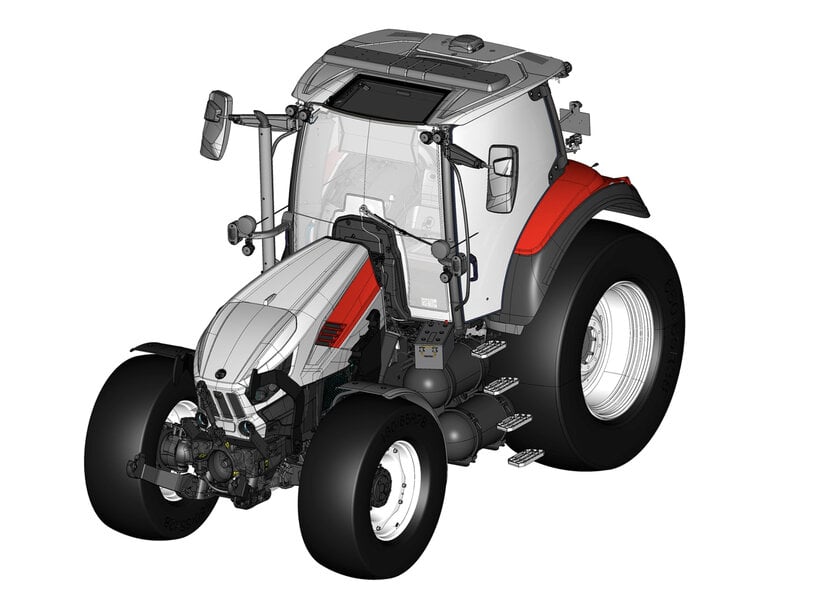
STEYR, in collaboration with TU Wien and industry partners, has introduced the HYTRAC research project to evaluate a direct-injection hydrogen internal combustion engine tractor integrated with an on-site generation and refuelling framework for decarbonised agricultural operations.
Direct-Injection Combustion and Electric Power-Split Architecture
Heavy-duty agricultural field tasks demand continuous high-load torque curves that challenge electrochemical battery-electric drivetrains due to volumetric weight penalties and extensive recharge downtime. Building on research from the fuel cell-powered STEYR FCTRAC concept presented in July 2024, the HYTRAC initiative shifts the mechanical focus to an adapted hydrogen internal combustion engine (H₂ ICE). Adapted from a conventional STEYR Expert platform, the engine incorporates direct injection to supply continuous mechanical output comparable to baseline diesel configurations while eliminating greenhouse gas tailpipe emissions.
Tractive power and implement management utilize an electric power-split continuously variable transmission (eCVT) engineered by VDS Holding GmbH. Working in tandem with a high-voltage battery system developed by Voltfactory GmbH, the architecture allows bidirectional electrical power distribution. Mechanical power drives the wheel assemblies through the eCVT, while auxiliary electrical power operates external high-voltage field implements, minimizing hydraulic parasitic losses and maintaining extended operational runtimes across high-draft farm cycles.
Decentralised Fuel Infrastructure and Smart Energy Hub Integration
A persistent constraint in deploying non-fossil machinery in rural environments is the absence of commercial distribution infrastructure. The HYTRAC system pairs the research tractor with an on-farm hydrogen generation, compression, and dispensing architecture known as COMBHY. Operating at the Energy Hub Neusiedl in Neusiedl am See, Austria, the project is funded by the Austrian Research Promotion Agency (FFG) and the Climate and Energy Fund (Klima- und Energiefonds).
The fuel production framework derives hydrogen from existing local resources, including residual crop biomass, on-site wind turbines, and photovoltaic arrays. Energy conversion and dispensing operations are automated through predictive control software. The platform uses load curves, machinery consumption logs, and generation forecasts to regulate electrolysis and compression cycles, ensuring fuel availability aligns with seasonal field demand without destabilizing the local electrical grid.
Systems Evaluation and Carbon Abatement
Field evaluations in Neusiedl analyze operational mechanics under realistic multi-task schedules, recording real-time fuel mass flow, transmission efficiency, and battery state-of-charge under fluctuating tractive resistance. By validating vehicle performance alongside local hydrogen synthesis, the initiative establishes empirical benchmarks for energy-independent, low-carbon farm workflows.
Additional Context:
This section details technical specifications and competitive benchmarking not included in the original product announcement
Agricultural decarbonisation strategies focus primarily on three technical pathways: battery-electric systems, hydrogen fuel cells (FCEVs), and hydrogen internal combustion engines (H₂ ICE). In the off-highway tractor sector, projects such as the Fendt Helios (developed under the H2Agrar initiative) evaluated fuel cell systems. While fuel cells achieve system efficiencies near 50 to 60 percent, their high sensitivity to airborne particulate matter, mechanical vibration, and requirements for ultra-high-purity hydrogen (ISO 14687 Grade D) impose substantial filtration and capital costs in dusty agricultural environments.
In contrast, H₂ ICE platforms utilize established internal combustion manufacturing lines and tolerate lower fuel purities, reducing supply-side costs. Industrial manufacturers such as JCB have developed hydrogen-combustion architectures using port-fuel injection, producing approximately 55 kilowatts (74 horsepower) to 212 kilowatts. However, port fuel injection in hydrogen engines risks pre-ignition and backfire due to the low ignition energy of hydrogen (0.02 millijoules), which frequently forces manufacturers to operate at high excess-air ratios ($lambda > 2$), penalizing power density relative to diesel counterparts.
By applying high-pressure direct injection (DI) similar to development engines from MAN (such as the 16.8-liter MAN H4576) and Cummins (15-liter X15H), the HYTRAC engine introduces fuel after the intake valves close. This eliminates manifold backfiring, increases volumetric efficiency, and yields brake mean effective pressure (BMEP) metrics that closely mirror equivalent displacement diesel donor engines. When coupled to an electric power-split eCVT, the powertrain decouples engine rotational speed from ground velocity, holding the H₂ combustion unit in optimal brake thermal efficiency operating bands to mitigate nitrogen oxide emissions without complex exhaust aftertreatment configurations.
Edited by Natania Lyngdoh, Induportals editor, assisted by AI.
www.steyr-traktoren.com
