
www.agritechmag.com
12
'26
Written on Modified on
AI Herd Assistant Turns Dairy Sensor Data Into Summaries
GEA is testing an AI layer for its DairyNet herd management system that interprets milk, activity and udder health data to support daily decisions on dairy farms.
www.gea.com
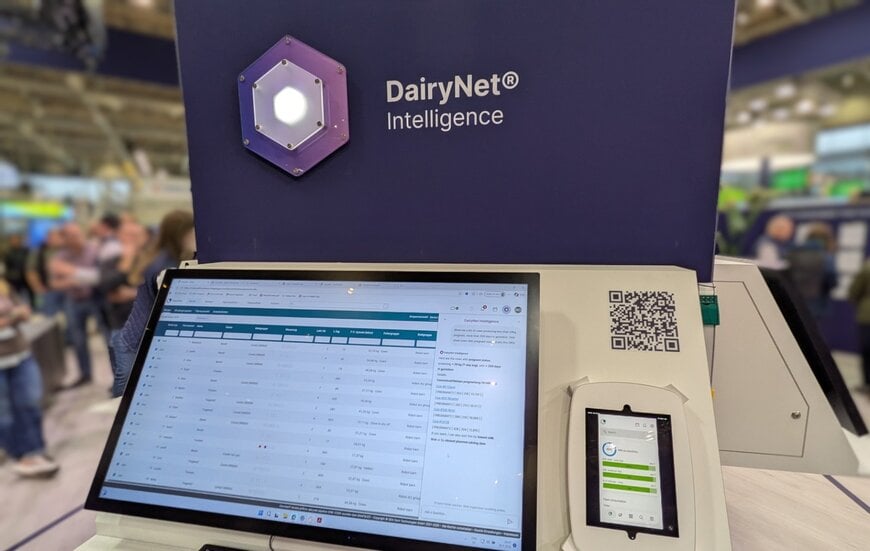
GEA has presented DairyNet Intelligence, an AI-powered assistant for its DairyNet herd management system, as a preview at EuroTier 2026 (10–13 November, Hanover, Germany; Hall 13, Booth C25). The assistant analyses health-related data for individual cows and summarises it for dairy farmers, with the aim of speeding up daily herd checks and the identification of animals that need closer attention.
The Data Review Problem in Dairy Herd Management
Assessing cow health on a modern dairy farm involves reviewing many separate indicators every day, from milk yield and activity to udder health parameters. In conventional herd management software, these metrics are spread across multiple screens and must be checked one by one. DairyNet already consolidates data from a range of GEA applications and systems; DairyNet Intelligence adds an AI layer that interprets this data rather than only displaying it.
How the AI Summary Works
The assistant analyses the health-related data held in DairyNet, including milk yield, animal activity, somatic cell count and milk conductivity, along with integrated data from CattleEye and CowScout. Somatic cell count and conductivity are established indicators of udder health, while activity data helps detect changes in behaviour. From these inputs, the system generates a short summary of each cow's current health status directly on the animal details page, making abnormal readings easier to spot.
In its current form, the assistant does not recommend specific actions; it is designed to help users review and interpret the available information more quickly. GEA is also testing a conversational interface in which users select predefined questions, for example to list the cows that currently require special attention. Future versions could generate analyses and visualisations and provide the specific information needed for a pending decision.
From Information Platform to Farm Operations Assistant
GEA describes DairyNet as evolving from a central information platform into a digital assistant for day-to-day operations. Planned functions include reminders for upcoming tasks, such as an alert before an AutoDry program begins preparing cows for the dry period, or initiating a veterinary appointment request when a cow's data indicates a potential health issue.
Because GEA supplies milking, feeding, manure management and herd management systems, DairyNet can serve as a shared data foundation for coordinating these processes. GEA cites examples such as a manure scraper cleaning walkways before cows arrive for milking, a feeding robot delivering fresh feed as soon as the first cows leave the milking parlour, and weather data being used to adjust feed quantities and feeding times on hot days. The assistant is also intended to support collaboration between farm managers, employees, veterinarians and advisors working from the same data, which is particularly relevant on farms where several people share responsibility for the herd.
Edge Architecture and Data Security
As more applications are connected, the security of the underlying infrastructure becomes more important. The DairyNet Box, an industrial PC installed on the farm, acts as the local technical platform and connects to the DairyNet Cloud. The architecture restricts internet access to reduce the potential attack surface, and GEA's risk assessment also covers physical access to the on-site hardware.
All key farm data is processed and stored locally on the DairyNet Box, so essential herd management functions remain available if the internet connection is limited or lost; data is synchronised automatically once the connection is restored. GEA states that it continues to develop this infrastructure to meet future requirements, including those of the European Cyber Resilience Act.
Availability
The AI functions shown at EuroTier are in the testing phase. GEA plans to make them available initially on selected farms in late 2026 or early 2027, with feedback from these deployments and from dealers guiding further development.
Additional Context
This section details technical specifications and competitive benchmarking not included in the original news release.
Herd management software is offered by the major milking-equipment suppliers, including DeLaval with its DelPro farm management system and Lely with its cloud-based Lely Horizon platform, both of which combine milking, activity and health data to flag cows for attention. These systems are typically compared on the range of sensor data they integrate, the quality of their health alerts, interoperability with third-party equipment, and whether core functions remain available offline. GEA's approach of keeping data processing on a local industrial PC, with cloud synchronisation, addresses the last of these criteria directly. On the regulatory side, the EU Cyber Resilience Act entered into force in December 2024; its vulnerability and incident reporting obligations apply from September 2026, and its full security requirements for products with digital elements apply from December 2027, making secure-by-design architectures increasingly relevant for connected farm equipment.
Edited by Aishwarya Mambet, Induportals Editor, with AI assistance.
www.gea.com
