
www.agritechmag.com
28
'26
Written on Modified on
Ammonia Combustion Engine for Heavy Agricultural Machinery
MAN Engines, CLAAS, and WTZ Roßlau develop a carbon-free powertrain to solve off-highway duty cycle demands under continuous high-load operations.
www.man.eu
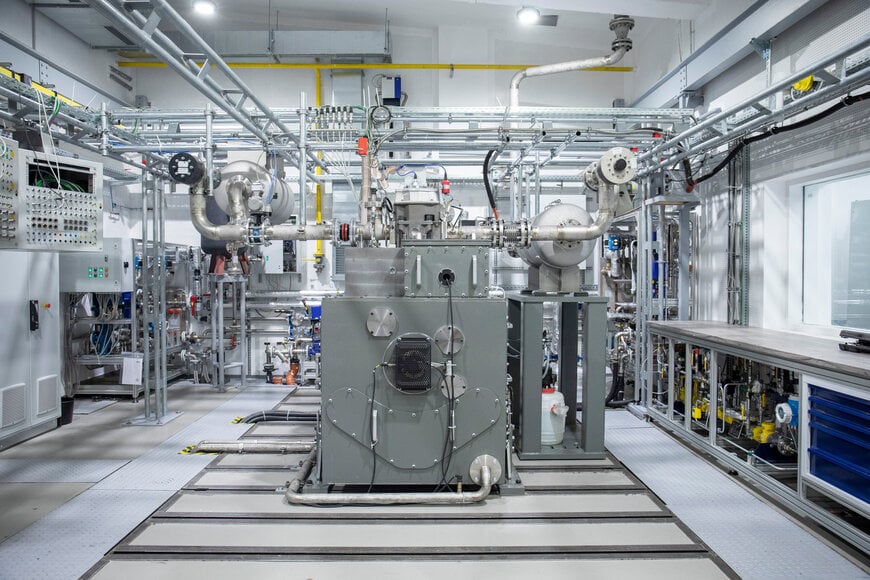
MAN Engines, agricultural machinery manufacturer CLAAS, and research institute WTZ Roßlau are collaborating on the GAMCO (Green Ammonia Multifuel Combine) research project to engineer an ammonia-based internal combustion powertrain for heavy off-highway equipment. Running through October 2029 under the 8th Energy Research Programme of the German Federal Government, the initiative investigates carbon-free alternative fuels for machines requiring extended duty cycles and continuous peak output.
Technical Operational Demands in Heavy Machinery
Heavy-duty agricultural machinery operates under specific duty cycles characterized by sustained high mechanical loads, long continuous runtime, and limited access to stationary charging networks. Battery-electric drives present energy density limitations in these performance-intensive scenarios.
Ammonia acts as a carbon-free energy carrier with high volumetric energy density compared to gaseous hydrogen. However, ammonia combustion introduces specific engineering hurdles, including low flame velocity, narrow flammability limits, and high auto-ignition temperatures. Solving these parameters requires specialized combustion chamber architecture, adapted fuel injection strategies, and modified simulation models.
System Architecture and Partner Responsibilities
The GAMCO initiative divides development tasks across three specialized domains:
MAN Engines designs and models the internal combustion engine architecture. The engineering team applies simulation workflows and structural adaptation to assess fuel delivery, ignition dynamics, and mechanical durability under ammonia combustion.
WTZ Roßlau performs scientific testing and validation of the multifuel combustion process. The institute analyzes in-cylinder combustion kinetics, emissions control requirements, and engine efficiency profiles across defined load steps.
CLAAS oversees vehicle integration parameters. The manufacturer defines operational boundaries, space-claim envelopes, thermal management needs, and functional requirements for combine harvesters and heavy farm implements.
Engineering Implementation and Practical Validation
Initial testing evaluates combustion stability on specialized dynamometers, followed by validation under practical operating conditions to verify real-world transient response. The multifuel approach ensures the powertrain maintains load-following capability while transitioning between energy sources.
"The decarbonization of heavy-duty off-road applications will not be solved by a single technology. It is therefore important to scientifically examine different energy sources and drive concepts and to evaluate their potential realistically," says Werner Kübler, Head of Engineering MAN Engines. "With our experience in the development and simulation of modern combustion engines, we are making a significant contribution to evaluating the technical feasibility of ammonia-based drive concepts for performance-intensive applications."
Expected Technical Outcomes
The project delivers empirical performance profiles, emissions assessments, and functional feasibility standards for ammonia multifuel systems in heavy mobile machinery. Results will define how ammonia fuel storage, handling, and combustion mechanics perform under practical mechanical stress, establishing an engineering roadmap for alternative energy deployment across off-highway mobile equipment.
Edited by Evgeny Churilov, Induportals Media - Adapted by AI.
www.man.eu
