
www.agritechmag.com
28
'26
Written on Modified on
Bale Singulation Chute Optimizes Field Collection Efficiency
AGCO introduced a hydraulic singulation chute for the Massey Ferguson SB.1436DB baler to streamline downstream forage retrieval into a single pass.
www.agcocorp.com
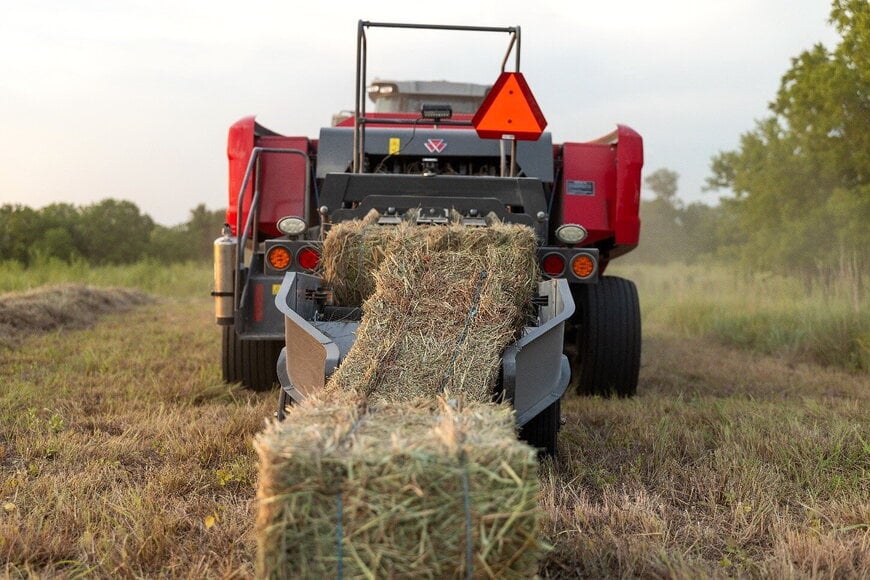
Commercial hay and forage operations face tight weather windows where field-clearing speed directly dictates crop quality and labor expenditures. While dual-chamber baling technology increases in-field output by pressing two small square bales concurrently, standard double-wide discharge patterns require retrieval equipment to make redundant passes or execute complex maneuvering across fields.
Addressing this downstream logistics bottleneck, AGCO presented a hydraulic singulation chute engineered specifically for the dual-discharge Massey Ferguson SB.1436DB small square baler. The implement addresses the operational disconnect between high-capacity dual-chamber baling and post-baling collection workflows by aligning finished packages into an in-line path.
Mechanical Operating Principle and Hydraulic Sequencing
The Massey Ferguson SB.1436DB produces two 14-by-18-inch bales simultaneously across twin chambers. Rather than dropping packages side by side onto the stubble, the singulation chute alternates package release using an integrated hydraulic timing mechanism.
As finished bales exit the chambers, the hydraulic drive indexes one bale forward before releasing the adjacent package. This controlled delay drops both units sequentially along the centerline of machine travel. Adjustable mechanical paddles regulate the feeding cadence, allowing field operators to calibrate release timing according to varying bale lengths.
Hydraulic power links directly to an onboard pump located on the baler chassis, requiring only a single auxiliary hydraulic line from the tractor remote to manage overall raise and lower functions.
Field Dynamics, Ground Following, and Maintenance Architecture
Trailing behind a high-capacity baler over variable field terrain requires decoupled suspension dynamics to prevent ground strike and structural fatigue. The attachment utilizes a patent-pending chassis system equipped with caster wheels and a dedicated suspension assembly. This running gear permits the chute structure to float independently of the baler tongue angle, maintaining clearance across irrigation ditches, wheel ruts, and uneven headlands.
For highway transit and headland turns, the operator can actuate the hydraulic circuit to elevate and mechanically lock the chute structure into an upright transport orientation. This elevated lock position also functions as a safety service stand, exposing the lower undercarriage for daily inspection. For routine belt servicing, the assembly utilizes spliced conveyor belts that allow technicians to replace drive sections without dismantling the primary roller shafts.
Integration in Commercial Forage Harvesting Systems
Dual-chamber small square balers substantially lower tractor engine operating hours during the pressing stage. However, handling two parallel lines of discharged bales has historically required multi-bale accumulators or twin collection runs by dedicated retrieval trucks.
By restructuring the field deposition pattern into an organized single row, the singulation chute permits standard self-propelled retrieval wagons and pull-type stackers to collect both bales in a continuous forward pass without repositioning. This elimination of redundant passes directly conserves diesel fuel, decreases field soil compaction, and reduces labor requirements across commercial acreage.
AGCO showcased the implement on the Massey Ferguson SB.1436DB during the 2026 Farm Progress Show, targeting high-volume commercial hay growers seeking systematic field transport optimization.
Additional Context
This section details technical specifications and competitive benchmarking not included in the original product announcement.
The base machine, the Massey Ferguson SB.1436DB, operates with a central split plunger mechanism generating two standard 14-by-18-inch cross-section bales within a frame comparable to large square balers. Traditional single-chamber small square balers operate at typical output rates of 400 to 700 bales per hour depending on windrow density. In high-density alfalfa and grass crops, the dual-chamber configuration doubles theoretical baling throughput per unit of travel time.
Industry handling systems for small square bales typically rely on three methods: automated trailing bale accumulators that bundle units into flat packs of 8 to 15 bales, side-loading automatic retrieval wagons, or manual crew pickup. Standard two-bale discharge tables release packages at an approximate 36-inch track center, requiring trailing accumulation equipment to either sweep across an excessive width or make multiple targeted passes. In contrast, singulation mechanics narrow the effective recovery corridor to standard single-pickup track dimensions (under 24 inches), aligning baler discharge with existing commercial stacker pick-up heads.
Similar singulation concepts in agricultural material handling rely either on mechanical gravity gates or powered differential conveyors. Gravity diversion systems often struggle with bale integrity in brittle straw or unevenly packed flakes. Powered conveyor singulation with hydraulic indexing, as implemented here, maintains uniform linear velocity regardless of ground slope or field moisture variations.
Edited by Evgeny Churilov, Induportals Media - Adapted by AI.
www.agcocorp.com
