
www.agritechmag.com
24
'26
Written on Modified on
John Deere Launches F8 and F9 Forage Harvesters with HarvestMotion
Combining high-torque low-RPM engine performance with automated ground speed control and ergonomic cab technology, the new harvesters boost crop throughput while reducing fuel consumption.
www.deere.com
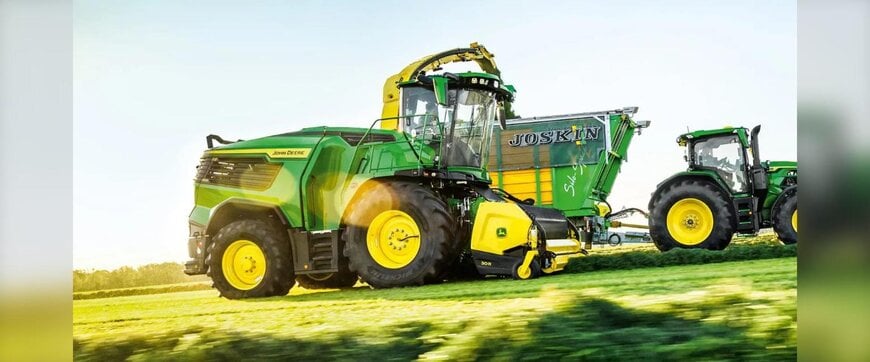
High-throughput agricultural harvesting operations face persistent engineering trade-offs between material processing capacity, fuel consumption, and operator fatigue. In dense silage crops such as maize, variable crop density creates rapid load fluctuations on the cutterhead and feedrolls. Maintaining consistent chop quality and throughput without stalling the drivetrain or burning excess fuel requires continuous adjustment of engine speed and forward travel velocity. To address these operational requirements in commercial forage harvesting and dairy or biogas feedstock production, John Deere developed the F8 and F9 series self-propelled forage harvesters.
Low-RPM Engine Torque Management Architecture
Traditional high-horsepower harvesting equipment often relies on high rotational engine speeds to maintain momentum under heavy crop loads, increasing parasitic mechanical losses and specific fuel consumption. The F8 and F9 forage harvesters address this thermodynamic and mechanical challenge through a drivetrain control concept designated as HarvestMotion, which comes as standard equipment across both series.
Instead of operating continuously near rated maximum engine speed, the engine control unit and power management system are calibrated to deliver elevated torque at reduced engine revolutions per minute. By shifting the operating point down the engine speed curve while maintaining high torque output, the drivetrain absorbs sudden surges in crop mass flow without requiring frequent downshifts or manual throttle intervention. For operations demanding higher peak output in heavy yields, an upgraded software and calibration tier, HarvestMotion Plus, further extends the available power band while preserving low-RPM fuel efficiency characteristics.
Closed-Loop Ground Speed and Load Control
Variable yield density across a single field frequently forces operators to manually modulate hydrostatic drive speed to prevent crop blockages or underutilization of the chopping cylinder. The F8 and F9 platforms integrate Ground Speed Automation to close the control loop between engine load and forward propulsion.
The control system continuously monitors engine load parameters and automatically regulates both forward ground speed and engine speed in real time. Operators select between two primary control strategies depending on field conditions and logistics requirements. In maximum engine capacity mode, the controller accelerates the harvester up to the thermal and mechanical load limit of the engine, maximizing metric tons harvested per hour. Alternatively, in custom speed set point mode, the system maintains a defined target velocity while automatically adjusting engine RPM to match the instantaneous power demand of the crop flow.
Operator Interface and Ergonomic Control Integration
Managing complex harvesting headers, spout positioning, and drivetrain settings during multi-hour shifts places high cognitive and physical demands on equipment operators. The cab architecture of the F8 and F9 models consolidates machine control and telemetry into a unified human-machine interface.
Primary machine functions are mapped to the CommandPRO joystick, which incorporates 11 customizable buttons allowing operators to assign header height, spout rotation, and automation triggers according to specific workflow preferences. System configuration, diagnostic monitoring, and automation set points are managed via the G5 or G5Plus CommandCenter touchscreen display. To mitigate physical strain during extended harvesting windows, the cab environment incorporates acoustic isolation for reduced interior noise levels, automated climate control, and an optional massage seat within a panoramic glass enclosure.
Model Lineup and Industrial Application Scope
The platform is divided into two distinct frame and powertrain configurations to match varying farm and contractor scale requirements. The F8 series is engineered for operations prioritizing maneuverability and mid-to-high throughput efficiency, whereas the F9 series is configured for high-capacity commercial harvesting, utilizing engine displacements up to 24 liters to sustain extreme mass flow rates in high-yielding forage crops. Both series integrate directly into large-scale silage production, livestock feed preparation, and anaerobic digestion feedstock supply chains where harvest window timing directly dictates dry matter quality and nutritional value.
Additional Context
This section details technical specifications and competitive benchmarking not included in the original product announcement.
In the self-propelled forage harvester sector, the shift toward low-RPM high-torque engine mapping aligns with broader off-highway powertrain engineering trends driven by EU Stage V and US EPA Tier 4 Final emissions regulations. Operating large-displacement diesel engines — such as the 24-liter V12 configurations utilized in top-tier harvesters — at reduced rotational speeds (typically between 1,400 and 1,650 RPM rather than 2,000+ RPM) minimizes friction losses and reduces exhaust aftertreatment thermal stress while extending component service intervals.
Within the high-capacity forage harvester market, the John Deere F8 and F9 series compete directly against established platforms such as the Claas Jaguar 900 series, Krone BiG X series, and New Holland FR Forage Cruiser lineup. Comparable load-based propulsion systems in this equipment class include Claas Cruise Pilot and Krone ConstantPower, which similarly monitor engine load and crop intake volume to modulate hydrostatic ground speed automatically. While exact horsepower ratings, cutterhead drum widths, and kernel processor specifications vary across specific F8 and F9 sub-models, the integration of 24-liter displacement options places the upper tier of the F9 lineup in the ultra-high-capacity segment alongside competitors exceeding 900 to 1,100 horsepower.
Edited by Evgeny Churilov, Induportals Media - Adapted by AI.
www.deere.co.uk
