
www.agritechmag.com
24
'26
Written on Modified on
Forage harvester fuel consumption per tonne field test
The John Deere F8 600 used the least fuel per tonne in a grass harvesting comparison by Koneviesti and the University of Oulu.
www.deere.com
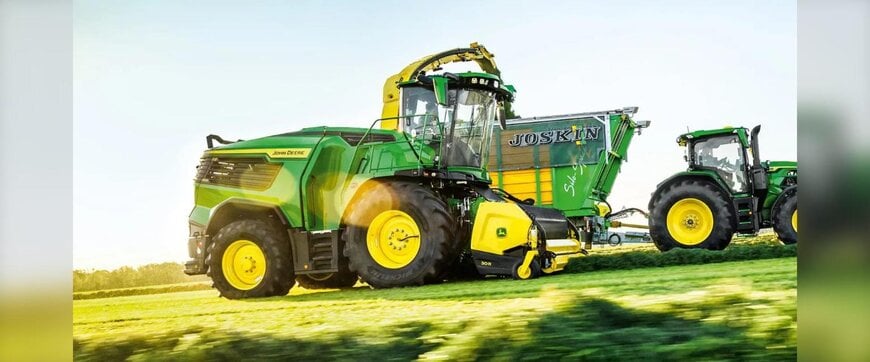
Fuel is one of the largest operating costs of a self-propelled forage harvester, which runs high engine loads for long hours during short harvest windows. Fuel consumption per tonne harvested is therefore a more meaningful efficiency indicator than consumption per hour. In an independent comparison carried out in Finland in August 2026, the John Deere F8 600 recorded the lowest fuel consumption per tonne harvested among three machines.
Test Method and Machines Compared
The grass harvesting comparison was organised by the Finnish agricultural magazine Koneviesti together with the University of Oulu. Three self-propelled forage harvesters were evaluated under identical field conditions: the John Deere F8 600 (645 PS), the New Holland FR650 and the Claas Jaguar 950 (585 PS). Each machine harvested four trailer loads from the same field section, so yield, crop moisture and field conditions were comparable. Koneviesti published the results on 10 September 2026.
Fuel Consumption Results
The F8 600 used up to 23% less fuel per tonne than the Claas Jaguar 950. Average consumption was 44 l/h for the F8 600 and 54 l/h for the Jaguar 950. John Deere calculates savings of up to EUR 20 per hour in fuel costs, or up to GBP 12 per hour based on a diesel price of GBP 1.20 per litre.
Engineering Factors Behind Fuel Efficiency
John Deere attributes the result to engine management, crop flow optimisation and the forage harvesting technology of the F8 600. In a forage harvester, most engine power is consumed by the cutterhead, crop processor and blower; smooth crop flow through feed rolls, chopping and discharge reduces power peaks and losses, so less fuel is needed for each tonne processed. Engine management that matches engine speed and power output to actual crop load avoids running at full output when throughput does not require it.
Relevance for Contractors and Large Dairy Farms
For contractors and large livestock operations harvesting grass silage over several cuts per season, a difference of around 10 litres per hour accumulates across the harvesting season. Lower consumption per tonne also reduces CO2 emissions per tonne of forage produced.
Further details are available on the F8 600 model page.
Additional Context
This section details technical specifications and competitive benchmarking not included in the original product announcement.
Independent forage harvester fuel measurements are carried out by organisations such as DLG in Germany, whose test reports express efficiency as litres per tonne of fresh or dry matter under defined crop conditions. Results depend strongly on crop type, dry matter content, chop length and processor settings, so values from a single grass comparison are not directly transferable to maize harvesting. The John Deere announcement does not publish per-tonne values, harvested mass or chop length settings, nor results for the New Holland FR650.
Edited by Evgeny Churilov, Induportals Media - Adapted by AI.
www.deere.co.uk
