
CAN-Bus Controlled Work Lighting for Agricultural Tractors
FORVIA HELLA supplies the UltraVision CAN-bus work lighting system for Fendt tractors, delivering up to 114,700 lumens with individual lamp control from the tractor terminal.
www.hella.com
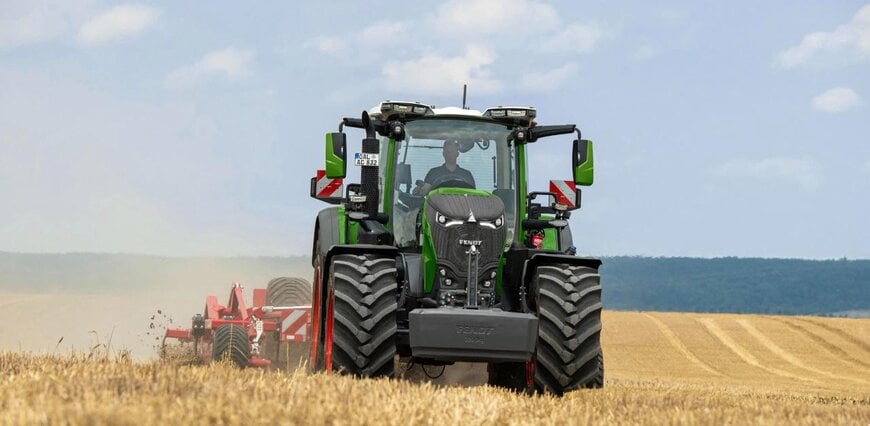
Agricultural operations rely on tight seasonal windows for sowing and harvesting, frequently requiring machinery to work late into the night. To provide precise, low-glare illumination around large farm equipment, automotive supplier FORVIA HELLA has developed a CAN-bus controlled work lighting system in close partnership with Fendt, the premium brand of US agricultural machinery manufacturer AGCO.
High-output LED work lamps are essential for monitoring implements, soil conditions and surrounding vehicles after dark. When working alongside companion vehicles, however, high-intensity beams can dazzle other operators or reflect off the tractor bonnet, causing self-glare. Addressing these constraints requires a networked lighting architecture capable of fine brightness control and individual lamp addressing directly from the cab terminal.
CAN-Bus Architecture and Individual Module Addressing
FORVIA HELLA supplies the complete work lighting system for the fifth-generation Fendt 800 Vario, the Fendt 1000 Vario Gen4 and the second-generation Fendt 1100 Vario MT tracked tractor. For the first time in the agricultural sector, almost all of the work lighting is controlled via CAN-bus, enabling precise, individual control of every single lamp. It is also the first time Fendt has used CAN-bus lighting control in agricultural machinery.
The UltraVision package equips the vehicle with up to 22 work lamps. Each 46-watt module delivers around 4,400 lumens and combines three light distributions, for near, medium and long range, into a homogeneous light pattern. On the Fendt 800 Vario, the 360-degree UltraVision concept produces up to 96,800 lumens in total, while on the Fendt 1000 Vario the system reaches up to 114,700 lumens.
“With the UltraVision system, we have developed visionary work lighting together with AGCO/Fendt that brings light exactly where it is needed in each situation: low-glare, powerful and software-controlled,” says Dr. Fabian Utermöhlen, Vice President Sales & Marketing in the Business Group Lifecycle Solutions at FORVIA HELLA. “The CAN-bus architecture with individually addressable modules and the thermal performance in a plastic housing show how precision and efficiency can be significantly increased.”
Real-Time Terminal Control and Standard Version
All work lamps can be controlled centrally via the tractor terminal at the touch of a button. Operators can adjust the lamps in real time, for example to reduce self-glare from reflections on the bonnet or to take an accompanying vehicle into account. The system offers a five-stage dimming function for fine brightness adjustment, flexible grouping of several lamps and a mirroring function for the synchronised control of entire light groups. Up to four individual user profiles can be stored, so drivers can switch between personally configured lighting settings at the touch of a button.
Alongside the UltraVision package, the portfolio includes a standard version for base equipment. Built on FORVIA HELLA’s proven S-Series, it operates without software control and is designed for applications where cost-effectiveness is the priority. Using an existing platform reduced development effort and time to market, while bringing the quality, reliability and know-how from numerous series projects into the new solution.
Additional Context
This section details technical specifications and competitive benchmarking not included in the original product announcement.
The transition from conventional switched power circuits to networked CAN-bus lighting represents a significant architectural shift in agricultural and off-highway vehicle electronics. Historically, adding individually controllable work lamps required dedicated wiring harnesses, physical switches and relay boxes, increasing wiring complexity and diagnostic effort. A serial CAN-bus topology, widely used in agricultural machinery, allows control units to send dimming commands and read diagnostic information from each lamp node over a shared data line.
From an optical and thermal engineering perspective, achieving more than 4,000 lumens per module within a plastic housing requires effective heat management, while reducing weight on the cab roof compared with metal housings. Software-defined 360-degree lighting with stored user profiles is becoming an important differentiator in the high-horsepower tractor segment, where manufacturers increasingly compete on operator visibility and comfort during night work.
Edited by Maria Brueva, Induportals editor – adapted by AI.
