
www.agritechmag.com
09
'26
Written on Modified on
Twin-Basket Hay Rake For Clean Windrow Formation
New Holland introduces the upgraded Rolabar 230 Plus rake in Australia to reduce soil contamination and leaf loss in forage harvesting operations.
www.newholland.com
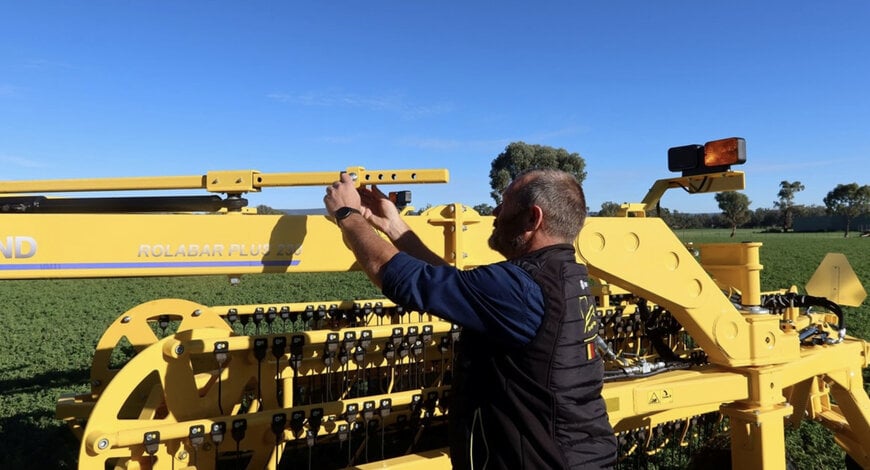
Commercial hay and forage producers face the persistent operational challenge of gathering wide swaths within narrow weather windows while preventing soil and rock ingestion that degrades feed quality. To address this production requirement across dairy, beef, and export hay industries, New Holland has launched the upgraded Rolabar 230 Plus twin-basket parallel-bar rake in Australia, providing an agricultural machinery solution that forms uniform windrows in fewer field passes.
Contamination Control and Leaf Retention in Forage Harvesting
In commercial haymaking and livestock feed production, mechanical raking directly influences the nutritional value, colour, and market grade of the final bale. When raking implements contact uneven paddock surfaces too aggressively, tines scrape the soil and introduce dirt, stones, and field debris into the windrow. This exogenous contamination increases total ash content, accelerates wear on downstream baler pickup and cutterbar components, and introduces spoilage microorganisms into stored forage. At the same time, excessive mechanical agitation shatters fragile, nutrient-dense leaves in legume and cereal hay crops.
Building on a parallel-bar raking concept that has been part of the manufacturer's haymaking range for more than 50 years, the upgraded Rolabar 230 Plus addresses these harvesting constraints through a synchronised sweeping and lifting action. Rather than dragging forage across the ground surface, the basket tines sweep and lift the cut crop in a single continuous motion. According to Sune Nielsen, Product Manager Hay and Forage at New Holland, this kinematic trajectory leaves dirt in the paddock while placing clean hay into the windrow, and the gentle tine action minimises leaf loss to retain nutritional value.
Structural Reinforcements and Mechanical Basket Flotation
To maintain consistent ground contour following across undulating paddocks, the Rolabar 230 Plus incorporates full mechanical basket flotation alongside structural reinforcements in high-stress frame zones. The mechanical flotation system supports overall basket integrity while allowing the raking assemblies to track surface variations independently, preventing tine digging on ridges and avoiding missed crop in depressions.
New Holland has also re-engineered the basket frame geometry and redesigned the tine stripper bars. The updated basket frame brings the two raking baskets closer together at the centreline. This narrower central convergence allows operators to form tighter, more cohesive windrows while preserving crop quality and colour. Externally, the implement adopts a full yellow livery to match the wider New Holland hay and forage equipment line.
Technical Specifications and Operational Capacity
For large-scale haymaking operations working against approaching rain or shifting humidity levels, field throughput determines how much crop can be baled at optimal moisture content. The Rolabar 230 Plus utilizes two 12-foot (3.66-metre) raking baskets to gather up to 9.14 metres (30 feet) of crop into a single central windrow. This 9.14-metre maximum working width consolidates multiple mower-conditioner swaths in a single pass, reducing total tractor travel distance, soil compaction, and fuel consumption per hectare.
As Nielsen noted, reducing the number of required passes increases the total ground area an operator can cover within a day during restricted weather windows.
Integration into Agricultural Workflows and Tractor Compatibility
Within commercial forage workflows across Australia, hay is produced for both domestic beef and dairy herds as well as strict quality-controlled export markets. Field conditions and swath density vary significantly between first-cut cereal hay and subsequent lucerne or pasture cuts. To accommodate these variations, the Rolabar 230 Plus allows operators to adjust basket settings to match specific crop densities and paddock topography. Depending on harvest requirements and moisture levels, the dual baskets can be configured either to merge two swaths into a single heavy windrow for high-capacity balers or to turn an existing windrow to accelerate curing and dry-down.
From a fleet integration standpoint, the implement is engineered with a low hydraulic requirement. This design allows farms and agricultural contractors to pair the rake with a wide range of existing utility and row-crop tractors without requiring high-capacity auxiliary hydraulic pumps.
Additional Context:
This section details technical specifications and competitive benchmarking not included in the original product announcement.
In commercial forage harvesting, mechanical hay rakes are generally categorised into three primary architectures: ground-driven wheel rakes, hydraulically driven parallel-bar (twin-basket) rakes, and PTO-driven rotary rakes. Agronomic field trials conducted by university extension programs, including studies from the University of Minnesota and Washington State University evaluating alfalfa harvesting at ground speeds between 8 and 14.5 km/h (5 to 9 mph), establish clear performance benchmarks across these three categories regarding exogenous ash content and leaf shatter.
In these industry benchmarks, ground-driven wheel rakes offer high operating speeds and low initial capital cost, but because their tined wheels rely on ground contact for rotation, they typically introduce the highest levels of soil contamination (ash content) into the windrow. Every 1 percent increase in exogenous ash contamination reduces total digestible nutrients (TDN) by approximately 1 percent. Conversely, hydraulically driven parallel-bar basket rakes—such as the New Holland Rolabar 230 series and comparable twin-basket systems like the Vermeer R2800—suspend the raking baskets above the soil surface using gauge wheels and flotation springs, driving the reel bars via hydraulic motors.
According to published New Holland technical documentation for the standard Rolabar 230 platform, the twin-basket architecture requires a minimum tractor hydraulic flow of 34 L/min (9 US gpm) and a minimum tractor power rating of 48 kW (65 hp), operating at field speeds between 3 and 16 km/h (2 to 10 mph). Standard 230-series baskets are configured with either 6 or 7 tine bars carrying 37 rubber-mounted tines per bar (totalling 222 or 259 tines per basket) and fold to a transport width of 3.25 metres (10 feet 8 inches). Compared to PTO-driven twin-rotor rotary rakes, which excel in heavy, wet silage crops, hydraulic twin-basket rakes require fewer driveline wear parts and exhibit lower dry-matter leaf loss when handling dry, brittle legume hay under arid harvesting conditions.
Edited by Sucithra Mani, Induportals editor – adapted by AI.
www.newholland.com
