
www.agritechmag.com
09
'26
Written on Modified on
Precision Agriculture Technology and Tractor Drivetrain Systems
Case IH integrates FieldOps farm management, Axial-Flow 160 combine automation, ActiveDrive 8 transmissions, and Optum 440 suspension to optimize agricultural field workflows.
www.casece.com
Modern commercial farming operations face tightening operational windows, fluctuating crop conditions, and increasing pressure to coordinate mixed machinery fleets across soil preparation, planting, crop protection, and harvesting. To address the need for unified machine control and data interoperability in agriculture, Case IH is introducing an integrated ecosystem of precision agriculture technology, combine harvesting automation, and tractor drivetrain updates at EIMA International 2026 at BolognaFiere in Bologna, Italy, taking place November 10 to 14, 2026.
Integrating Precision Agriculture Technology into Field Workflows
In complex agricultural workflows, disconnection between field machinery and back-office farm management software frequently leads to logistical bottlenecks, suboptimal implement settings, and fragmented agronomic records. Bridging this gap requires real-time telemetry and machine-to-machine communication across every phase of the crop production cycle.
At EIMA 2026 in Hall 29, a dedicated CNH technology area demonstrates how connected machinery and digital tools coordinate field preparation, seeding, planting, targeted crop protection, and harvesting. Central to this architecture is Case IH FieldOps, a centralized farm management platform designed to consolidate machine telemetry, field boundaries, and operator teams into a single interface. By streaming real-time operational data, the platform enables agricultural managers to monitor work progress, coordinate fleet logistics, and execute data-driven agronomic decisions while maintaining interoperability with third-party partner platforms.
To lower the barrier to fleet digitalization, the Connectivity Included initiative removes recurring telemetry subscription fees on qualifying machinery, ensuring continuous access to connected services. For existing machinery fleets requiring modernization, the CNH Parts Area also features aftermarket precision guidance and implement control systems from Raven and Fleetpro, alongside CNH Parts & Service and CNH Capital lifecycle support.
Combine Harvester Automation and Mechanical Material Handling
During narrow harvesting windows, combine operators must continuously adjust threshing and separation parameters to match varying crop moisture, density, and terrain while managing unloading logistics. Relying solely on manual adjustments increases operator cognitive load and risks grain loss or mechanical plugging.
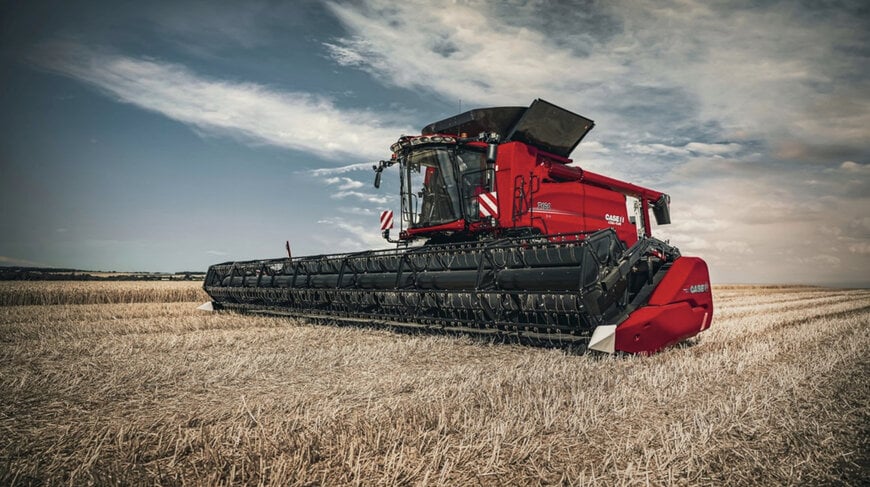
Making its first public appearance at an international exhibition, the Axial-Flow 160 series combine addresses these harvesting challenges by building upon Harvest Command combine automation technology. In the cab, Pro 1200 dual displays provide the operator with simultaneous visualizations of mechanical machine parameters and agronomic performance data. The control architecture incorporates automated guidance, automated headland turning, and machine-to-machine data sharing to synchronize multi-machine harvesting and unloading workflows.
On the mechanical side, the Axial-Flow 160 series introduces two specific drivetrain enhancements to improve material handling and hygiene. A cross-auger clutch mechanism allows the unloading auger to be emptied completely, reducing residual grain weight on the unloading tube and preventing cross-contamination when switching between different crop varieties. Additionally, an optional two-speed feeder drive enables operators to adjust crop feeding velocity mechanically to maintain consistent throughput across changing crop conditions.
Dual-Clutch Tractor Transmission and Automated Suspension Control
Medium- and high-horsepower tractors must transition frequently between heavy draft tillage, precision power-take-off (PTO) work, and high-speed road transport. Matching drivetrain characteristics and chassis stability to these contrasting load profiles is essential for fuel efficiency, traction, and operator ergonomics.
For the 155 to 185 horsepower segment, Case IH has expanded the drivetrain options on the Puma 155–185 series tractors by introducing the ActiveDrive 8 transmission, demonstrated on the Puma 185 model, a finalist in the Tractor of the Year competition with results announced on November 10, 2026. Utilizing dual-clutch technology, the ActiveDrive 8 transmission pre-selects the subsequent gear ratio to execute torque-interruption-free gear shifts across both heavy field applications and road transport. The updated Puma range pairs this drivetrain with improved chassis maneuverability, updated front axle and cab suspension systems, redesigned operator controls, and integrated precision implement management to mitigate fatigue during extended shifts.
In the higher horsepower segment, represented alongside the Steiger 555 Quadtrac and Farmall 110M tractors, the Optum 440 tractor addresses chassis dynamics through its Advanced Vehicle Suspension (AVS) system, which received the EIMA Technical Evolution (Evoluzione Tecnica) award. Available across the Optum 360–440 series, AVS utilizes real-time sensor feedback to monitor vehicle velocity and operating conditions, automatically modulating suspension damping rates to maintain tractor stability and ride comfort without requiring manual intervention.
“That means making precision technology easier to use, bringing machine and field information together and offering transmission choices that suit the work customers need to do,” said Anthony Jasinski, Case IH Brand Communications & Press Relations Manager EMEA. “The recognition for the Optum tractor - Advanced Vehicle Suspension reflects this practical approach: advanced engineering that supports comfort without adding another task for the operator.”
Case IH is detailing these engineering methodologies during its press conference on November 10, 2026, at 10:00 a.m. under the theme Designing for the Farmer of the Future, examining how field challenges and operator feedback govern industrial design and mechanical validation.
Additional Context:
This section details technical specifications and competitive benchmarking not included in the original product announcement.
In the agricultural machinery sector, tractor transmission architecture is divided primarily between multi-range powershift (including dual-clutch) systems and continuously variable transmissions (CVTs). Dual-clutch transmissions, such as the Case IH ActiveDrive 8 (which provides 24 forward and 24 reverse speeds across three ranges with eight powershift steps per range in established CNH architectures), use two alternating clutches—one for odd gears and one for even gears—to maintain mechanical drive efficiency and minimize parasitic hydraulic losses during draft work. This design competes directly in the 150 to 200 horsepower utility and row-crop segment against comparable powershift and dual-clutch transmissions, such as the John Deere DirectDrive (an 8-speed, three-range dual-clutch transmission) and the Massey Ferguson Dyna-6 and Dyna-7 semi-powershift systems, offering an alternative to stepless CVTs (like Case IH CVXDrive or Fendt Vario) when mechanical power transfer efficiency and lower upfront capital cost are prioritized.
In combine harvesting, the Axial-Flow single-rotor threshing and separation concept relies on rotor-to-concave grain-on-grain rubbing rather than the tangential drum-and-straw-walker or twin-rotor hybrid architectures used by competitors such as Claas (Lexion and Trion series), John Deere (T-Series and X9), and New Holland (CR Twin Rotor series). Automated combine control systems—such as Case IH Harvest Command, Claas Cemos Automatic, and John Deere HarvestSmart—increasingly rely on acoustic grain-loss sensors, camera-based grain quality analysis, and engine load monitoring to modulate ground speed, sieve openings, fan speed, and rotor speed automatically. Across all machinery categories, farm management information systems (FMIS) like Case IH FieldOps operate alongside industry benchmarks such as the John Deere Operations Center and Claas Connect, relying on ISO 11783 (Isobus) communication standards to ensure cross-brand implement compatibility and telemetry exchange.
Edited by Sucithra Mani, Induportals editor – adapted by AI.
www.cnh.com
