
www.agritechmag.com
09
'26
Written on Modified on
Large-Scale Row Planter Expands Precision Seeding Capacity
Agricultural machinery manufacturer Fendt engineered an eighty-foot planting implement to optimize operational efficiency and seed-placement accuracy across broad-acre crop production environments.
www.fendt.com
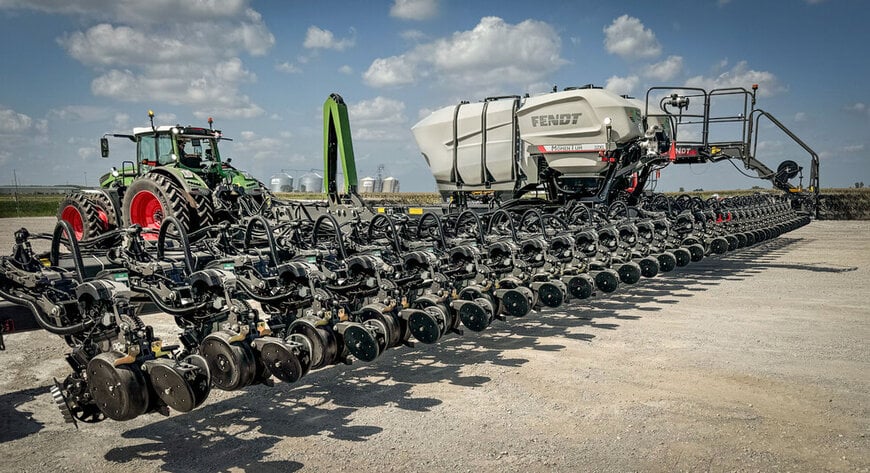
Commercial broad-acre agricultural operations rely on planting precision to optimize germination rates and uniform crop emergence. Operating as an integrated planting system, the newly developed 80-foot, 32-row planter with 30-inch spacing interfaces with high-horsepower agricultural tractors to address seeding throughput and field compaction in extensive row-crop applications.
Terrain Adaptation via Five-Section Toolbar Articulation
Consistent seeding depth across undulating terrain presents a key engineering challenge for wide-span implements. The unit debuted at the 2026 Farm Progress Show, introducing an articulated five-section Vertical Contouring Toolbar. By expanding articulation points beyond preceding three-section architectures, the toolbar accommodates wide operational spans while maintaining 52 inches of vertical row-unit travel. This degree of articulation ensures that independent row assemblies mirror terrain variations, including contours and terrace transitions, preventing depth drift and maintaining uniform vertical placement without skipping or shallow seed drops.
Dynamic Hydraulic Weight Distribution and Compaction Mitigation
Soil compaction within the central wheel tracks directly impedes root development. To regulate axle loading without manual operator intervention, the platform integrates an automated frame-weight management system designated as Load Logic Lite. Rather than deploying static downforce parameters across the entire implement width, hydraulic circuitry actively redistributes chassis weight away from heavily loaded central axles toward outer frame sections. This automated weight transfer minimizes ground-bearing pressure across central rows while preserving sufficient row-unit ground contact across outer wings. Despite an operating width of 80 feet, the chassis folds into a transport envelope of 12 feet, allowing transport between dispersed fields.
On-Board Consumable Capacities and Tractor Integration
High-capacity onboard consumable storage reduces the frequency of refill stops during short planting windows. The machine integrates a standard 130-bushel central seed hopper alongside a 1,000-gallon liquid fertilizer system. Integrated seeding meters and electronic downforce hardware from Precision Planting function alongside the factory chassis monitoring controls. The implement is optimized for high-power drawbar tractors, including the 1000 Vario wheeled series and the 1100 Vario MT tracked series, synchronizing implement rate commands with onboard tractor telematics and guidance networks. Commercial orders for the system open in the United States and Canada in the summer of 2027.
Additional Context
This section details technical specifications and competitive bench marking not included in the original product announcement.
In the broad-acre seeding equipment sector, 80-foot, 32-row configurations represent the upper bound of standard-spaced commercial planting equipment. The benchmark within this segment includes the John Deere DB80, which similarly operates an 80-foot toolbar over 32 rows on 30-inch centers. The DB80 features central-commodity system capacities of 120 bushels of seed and up to 850 gallons of liquid fertilizer, while relying on automated hydraulic downforce and pneumatic or hydraulic frame wing weight transfer.
By comparison, the Fendt design expands bulk fluid capacity to 1,000 gallons and dry seed payload to 130 bushels, reducing logistics cycles. Structurally, while established architectures traditionally utilize three-section or forward-folding multi-hinge toolbars with lower total vertical travel, the five-section frame design paired with 52 inches of row-unit float targets more severe field topography. Furthermore, the 12-foot road transport width of the Fendt frame compares favorably against the 15-foot to 16-foot transport envelopes typical of competitive front-fold 80-foot toolbars, lowering clearance requirements during public road transit.
Edited by Evgeny Churilov, Induportals Media - Adapted by AI.
www.fendt.com
