
www.agritechmag.com
21
'26
Written on Modified on
Precision Spot Spraying for Targeted Crop Protection
Comparing AI computer vision weed detection from John Deere, AGCO, and New Holland to reduce herbicide volume in commercial row-crop farming.
induportals-media-publishing.com

Photo Credit: New Holland
Precision spot spraying replaces uniform broadcast chemical application with targeted crop protection, activating individual nozzles only when optical sensors detect weeds. By distinguishing weeds from bare soil or emerging row crops, this engineering approach reduces herbicide expenditure, limits chemical runoff, lowers crop phytotoxicity, and generates field-level weed pressure data for long-term agronomic management.
Current Technology Market Landscape
Ground-based precision spot spraying relies on two primary optical architectures: boom-mounted camera arrays and cab-mounted wide-angle vision sensors. Boom-mounted systems pair high-speed cameras spaced every 1.5 metres with pulse-width modulation valves, operating at speeds up to 24 km/h to execute real-time edge inference. Conversely, single forward-facing cab cameras monitor 15 metres ahead across a 41-metre field of view at speeds up to 40 km/h, dynamically adjusting variable-rate nozzle output across the entire boom.
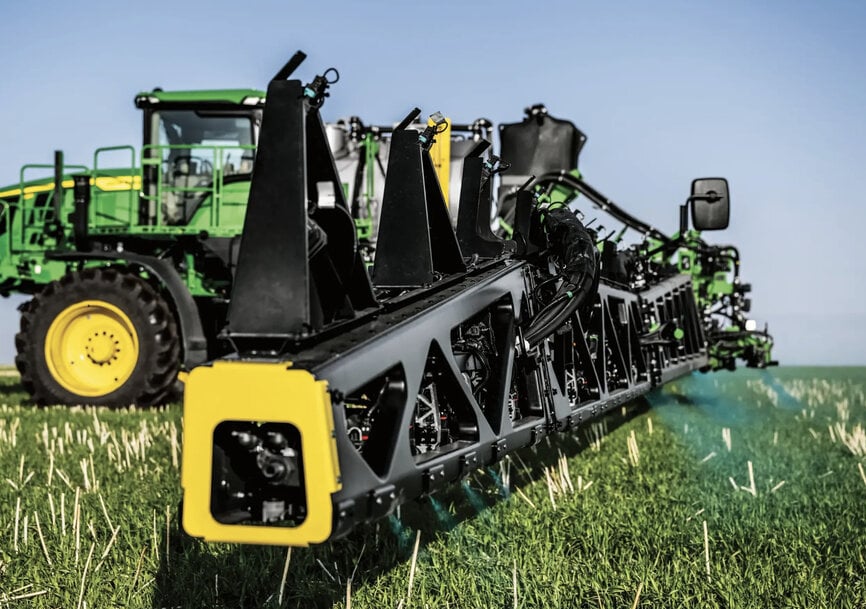
Photo Credit: John Deere
Core Market Challenge
High capital expenditure and recurring software licenses complicate return-on-investment calculations for mid-sized farms. While factory or OEM camera upgrades generally cost between $25,000 and $100,000 upfront—often paired with ongoing per-acre fees—full brand-agnostic aftermarket camera retrofits with no recurring fees typically run between $165,000 and $270,000 or more. Technically, dust, shadows, dense crop canopies, and low light degrade optical recognition, often requiring full-boom auxiliary lighting. High operating speeds also constrain image-processing latency; when sprayers exceed speed thresholds, systems must default to broadcast fallback modes, reducing chemical savings.
Existing Technology Solutions
John Deere ntegrates boom cameras and ExactApply nozzles in See & Spray Premium and Ultimate. Following 2025 software updates, both systems operate at speeds up to 24 km/h (15 mph). Dual-tank configurations are available on Ultimate (and Gen 2), while Premium uses a single-tank setup. Pricing includes per-acre licensing, an Unlimited Annual License option introduced for 2026, and free fallow applications.
AGCO provides brand-agnostic PTx SymphonyVision retrofits. Its SymphonyVision | Spot tier mounts cameras every 1.5 metres (5 feet) to cut contact herbicide use by up to 55% with one-time hardware ownership and no recurring operating fees, while its variable-rate-only SymphonyVision | Rate tier uses 3-metre (10-foot) spacing.
New Holland deploys factory-fit IntelliSense Sprayer Automation on MY2026 and newer Guardian sprayers using a single cab-mounted SenseApply camera with no subscription fees. It achieves up to 60% herbicide reduction in green-on-brown Selective Spot Spray mode, alongside seven live variable-rate application (VRA) modes that deliver 6% to 20% input savings depending on the pass (20% for burndown, 15% for harvest aid, 10% for nitrogen and plant growth regulators, and 6% for fungicides).
Actual implementation on the ground
Commercial John Deere See & Spray machines covered 1.26 million U.S. acres across 2023 and 2024, spraying 524,000 acres—a 58.4% reduction in sprayed area. By late 2025, commercial adoption had surpassed 5 million acres across corn, cotton, and soybeans, averaging nearly 50% herbicide savings (31 million gallons saved). In 2025 Precision Technology Institute (PTI) soybean trials, AGCO SymphonyVision cut chemical volume by 55%—turning off nozzles across 35 of 63 acres—and brought actual application costs down to $11 per acre against a $25 broadcast baseline, saving $14 per acre. For cab-mounted systems, a New Holland manufacturer benchmark for a 3,500-acre U.S. wheat farm—accounting for two fertiliser passes and one burndown pass—estimated full return on investment within one to two years.
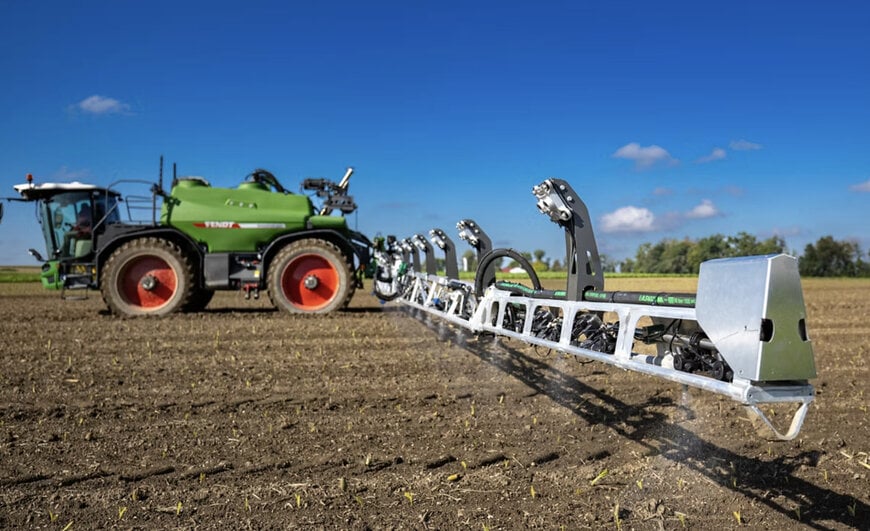
Photo Credit: AGCO
Summary and Strategic Future Outlook
Targeted crop protection has matured into commercial agricultural infrastructure, divided between factory-integrated machinery and brand-agnostic retrofits, alongside competing subscription and one-time hardware pricing models. Future engineering will expand green-on-green recognition to additional crops, integrate real-time biomass sensing for variable-rate fertilisation, and automate compliance reporting across cloud farm management platforms as chemical regulations tighten.
Edited by Maria Brueva, Induportals editor – adapted by AI.
www.agritechmag.com
Precision spot spraying replaces uniform broadcast chemical application with targeted crop protection, activating individual nozzles only when optical sensors detect weeds. By distinguishing weeds from bare soil or emerging row crops, this engineering approach reduces herbicide expenditure, limits chemical runoff, lowers crop phytotoxicity, and generates field-level weed pressure data for long-term agronomic management.
Current Technology Market Landscape
Ground-based precision spot spraying relies on two primary optical architectures: boom-mounted camera arrays and cab-mounted wide-angle vision sensors. Boom-mounted systems pair high-speed cameras spaced every 1.5 metres with pulse-width modulation valves, operating at speeds up to 24 km/h to execute real-time edge inference. Conversely, single forward-facing cab cameras monitor 15 metres ahead across a 41-metre field of view at speeds up to 40 km/h, dynamically adjusting variable-rate nozzle output across the entire boom.
Photo Credit: John Deere
Core Market Challenge
High capital expenditure and recurring software licenses complicate return-on-investment calculations for mid-sized farms. While factory or OEM camera upgrades generally cost between $25,000 and $100,000 upfront—often paired with ongoing per-acre fees—full brand-agnostic aftermarket camera retrofits with no recurring fees typically run between $165,000 and $270,000 or more. Technically, dust, shadows, dense crop canopies, and low light degrade optical recognition, often requiring full-boom auxiliary lighting. High operating speeds also constrain image-processing latency; when sprayers exceed speed thresholds, systems must default to broadcast fallback modes, reducing chemical savings.
Existing Technology Solutions
John Deere ntegrates boom cameras and ExactApply nozzles in See & Spray Premium and Ultimate. Following 2025 software updates, both systems operate at speeds up to 24 km/h (15 mph). Dual-tank configurations are available on Ultimate (and Gen 2), while Premium uses a single-tank setup. Pricing includes per-acre licensing, an Unlimited Annual License option introduced for 2026, and free fallow applications.
AGCO provides brand-agnostic PTx SymphonyVision retrofits. Its SymphonyVision | Spot tier mounts cameras every 1.5 metres (5 feet) to cut contact herbicide use by up to 55% with one-time hardware ownership and no recurring operating fees, while its variable-rate-only SymphonyVision | Rate tier uses 3-metre (10-foot) spacing.
New Holland deploys factory-fit IntelliSense Sprayer Automation on MY2026 and newer Guardian sprayers using a single cab-mounted SenseApply camera with no subscription fees. It achieves up to 60% herbicide reduction in green-on-brown Selective Spot Spray mode, alongside seven live variable-rate application (VRA) modes that deliver 6% to 20% input savings depending on the pass (20% for burndown, 15% for harvest aid, 10% for nitrogen and plant growth regulators, and 6% for fungicides).
Actual implementation on the ground
Commercial John Deere See & Spray machines covered 1.26 million U.S. acres across 2023 and 2024, spraying 524,000 acres—a 58.4% reduction in sprayed area. By late 2025, commercial adoption had surpassed 5 million acres across corn, cotton, and soybeans, averaging nearly 50% herbicide savings (31 million gallons saved). In 2025 Precision Technology Institute (PTI) soybean trials, AGCO SymphonyVision cut chemical volume by 55%—turning off nozzles across 35 of 63 acres—and brought actual application costs down to $11 per acre against a $25 broadcast baseline, saving $14 per acre. For cab-mounted systems, a New Holland manufacturer benchmark for a 3,500-acre U.S. wheat farm—accounting for two fertiliser passes and one burndown pass—estimated full return on investment within one to two years.
Photo Credit: AGCO
Summary and Strategic Future Outlook
Targeted crop protection has matured into commercial agricultural infrastructure, divided between factory-integrated machinery and brand-agnostic retrofits, alongside competing subscription and one-time hardware pricing models. Future engineering will expand green-on-green recognition to additional crops, integrate real-time biomass sensing for variable-rate fertilisation, and automate compliance reporting across cloud farm management platforms as chemical regulations tighten.
Edited by Maria Brueva, Induportals editor – adapted by AI.
www.agritechmag.com
